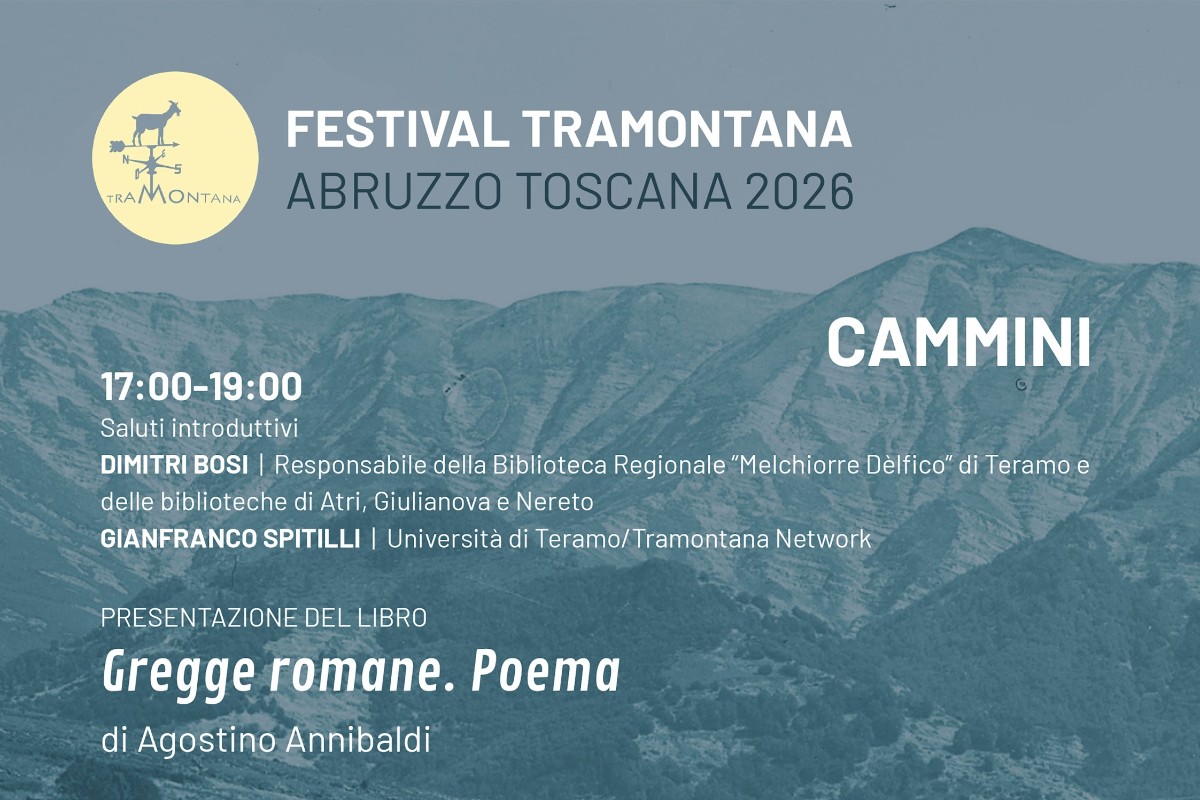
FESTIVAL TRAMONTANA ABRUZZO TOSCANA 2026: CAMMINI
«Gregge romane. Poema» by Agostino Annibaldi – book presentation
Biblioteca Regionale «Melchiorre Dèlfico», inner courtyard
Teramo, Italy
Thursday 5 November 2026, 17:00–19:00
This is an initiative of La Leggera, Bambun and LEM Italia as part of the “Creative Europe Tramontana IV” project.
The Italian edition of the Tramontana Festival, «Soglie | Cammini | Passaggi», runs from 24 October to 7 November 2026 in Tuscany and Abruzzo. Thursday 5 November brings two linked events of «CAMMINI» (Paths), its Abruzzo stage: a book presentation in Teramo in the afternoon and an evening of «canto a braccio» in Garrano Alto.
In the inner courtyard of the Biblioteca Regionale «Melchiorre Dèlfico», after a welcome by Dimitri Bosi, head of the library, and Gianfranco Spitilli (University of Teramo / Tramontana Network), the book «Gregge romane. Poema» by Agostino Annibaldi is presented. Fabrizio Deriu (University of Teramo) gives the opening talk, Gianfranco Spitilli discusses the book with its editors, Elio Di Michele, Giampiero Giamogante and Roberta Tucci, and Giovanni Kezich, former director of the Museo degli Usi e Costumi della Gente Trentina, gives the closing talk. The presentation ends with music and improvised poetry by the central Apennine poets Giampiero Giamogante, Francesco Marconi and Marcello Patrizi, with Francesco D’Elena on the ciaramelle.
“In 1942 – writes Roberta Tucci –, Agostino Annibaldi, a shepherd from Poggio Cancelli (AQ) who moved his flocks to the Roman countryside, completed his remarkable poem in hendecasyllables, «Gregge romane»: a unique work, comprising over two thousand five hundred verses divided into twelve chapters, in which the author distills all his knowledge and experience as a sheep farmer rooted in a family and regional context deeply tied to sheep herding, combined with an extraordinary, personal poetic flair. The poem traces the experience of the transhumant shepherd throughout the entire year, following the changing of the seasons.” Cut short by his death in 1944, Annibaldi’s poem, hitherto almost entirely unpublished, is now offered to readers as a “classic” of Apennine pastoral civilisation.