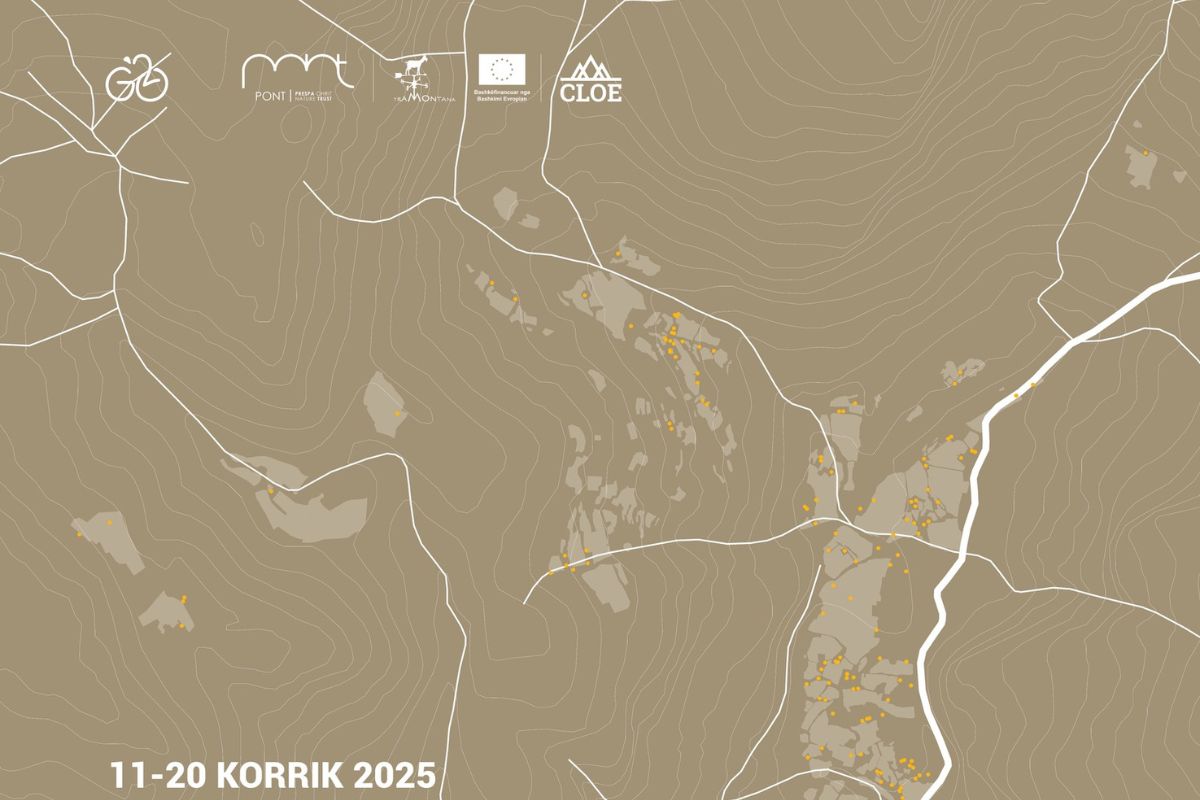
SUMMER SCHOOL OF THE ALBANIAN ALPS II
Mapping the Cultural Landscape in the Settlements of the Albanian Alps
Location: Nikç, Kelmend, Valley of Cemi, National Park “Albanian Alps”
Dates: 11-20 July 2025
Organised by: GO2Albania
Collaborators: Tramontana Network, Protected Areas Administration, Shkodër
Funded by: Prespa Ohrid Nature Trust – PONT, European Union, and the “CLOE” Project Marie Skłodowska-Curie Actions
The National Park “Albanian Alps” (IUCN Category II) was declared by DCM No. 59, dated 26.01.2022, as the largest park in Albania, covering an area of 82,844.65 hectares. Positioned in the northernmost part of the country, the park extends across the municipalities of Shkodër and Malësi e Madhe in the Shkodër District and the municipality of Tropojë in the Kukës District. To the south, it borders three nature parks: “Nikaj-Mertur” (2014), “Valley of Shala” (2022), and “Shkrel” (2016). To the north, it borders the “Prokletije” National Park (2009) in Montenegro, and to the northeast, the “Bjeshkët e Nemuna” National Park (2012) in Kosovo. Together, these parks form the Albanian Alps, which stretch across the southeastern extremity of the Dinaric Alps.
The Albanian Alps represent the most majestic region of Albania. They are the land of myths and legends, of the Songs of the Frontier Warriors and the Kanun, of heroes who set off for battle with songs of valour and are honoured with laments of men, of oaths and heroism. The Alps are the origin and territory of most of the 10 pure tribes of Gegëria, scattered throughout history from the Danube to the Aegean, and from the Apennines to beyond the Atlantic.
The traditional way of life of the inhabitants, from the river valleys to the deepest and most isolated streams, has evolved very slowly over the last 3,000 years, shaping the cultural landscape.
This landscape contains valuable historical, anthropological, archaeological, ecological, and spiritual heritage, often endangered by abandonment, modernisation, and climate change.
This 10-day summer school will take place in one of the deepest and best-preserved settlements of the Alps and will offer a unique and in-depth field experience for the exploration, documentation, and mapping of its cultural landscape to help understand rural civilisation in the highlands of Gegëria.
The programme creates an interdisciplinary space for fieldwork in the mountain settlement in the northern region of Albania, critical reflection, and collective knowledge production.
Objectives:
To explore and identify the cultural landscape of a mountain settlement through fieldwork.
To document the physical elements of the cultural landscape using interdisciplinary methods and interpret them.
To raise awareness of the values and threats facing mountain cultural landscapes as cherished heritage with anthropological, historical, cultural, and environmental significance.