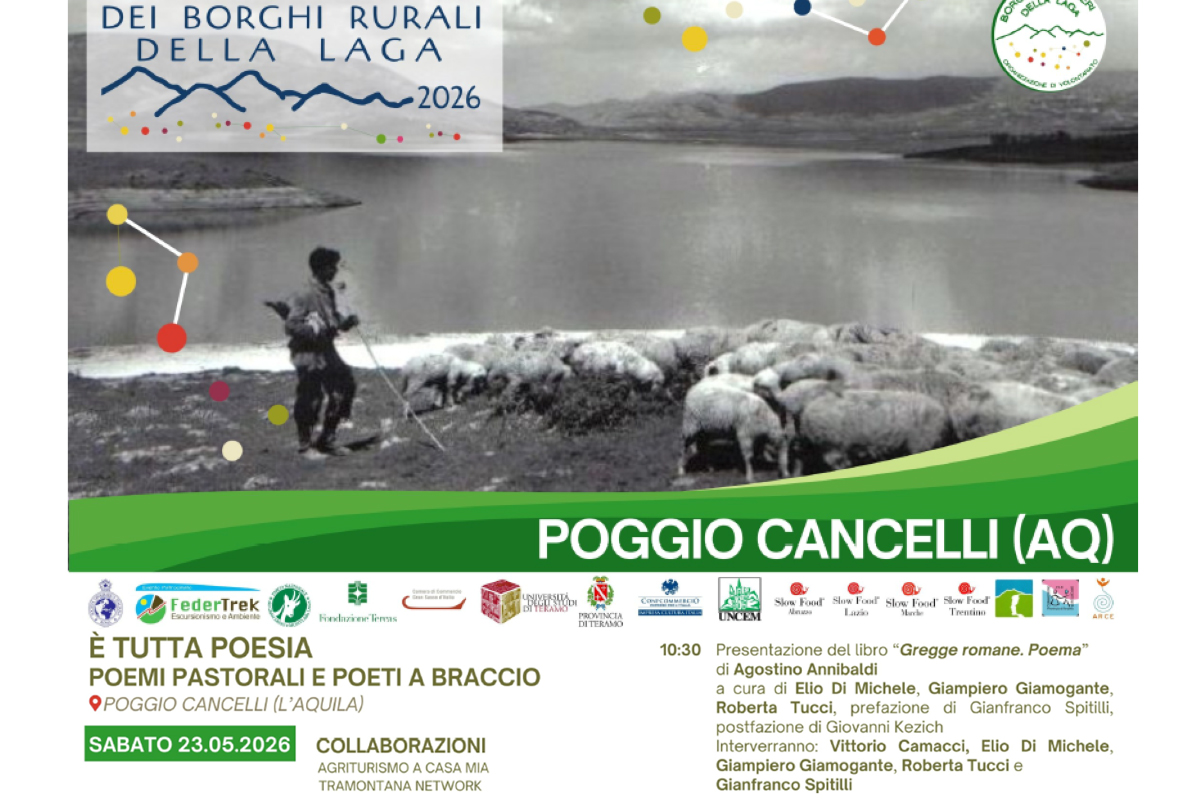
TROUPEAUX ROMAINS. POÈME
23 mai 2026
Maison Rascelli, L’Aquila
Campotosto – Italie
L’événement est organisé dans le cadre des activités du projet européen Tramontana Network.
La présentation du livre “Troupeaux Romains. Poème”, edité par Elio Di Michele, Giampiero Giamogante, Roberta Tucci, avec une préface de Gianfranco Spitilli et une postface de Giovanni Kezich, publié par Bambun/Centro Studi Don Nicola Jobbi en décembre 2025, aura lieu à la Maison Rascelli, à Poggio Cancelli, Campotosto, à partir de 10 heures, sous la coordination de Roberto Gualandri, avec des interventions de Vittorio Camacci, de Gianfranco Spitilli, des éditeurs de l’ouvrage et des poètes improvisateurs.
« En 1942 – écrit Roberta Tucci –, Agostino Annibaldi, un berger originaire de Poggio Cancelli (AQ) qui menait ses troupeaux dans la campagne romaine, acheva son remarquable poème en hendécasyllabes, “Troupeaux Romains” : une œuvre unique, composée de plus de deux mille cinq cents vers répartis en douze chapitres, dans laquelle l’auteur distille tout son savoir et son expérience d’éleveur de moutons ancré dans un contexte familial et régional profondément lié à la transhumance », le tout combiné à un talent poétique personnel extraordinaire. « Le poème retrace l’expérience du berger transhumant tout au long de l’année, au fil des saisons : la montée vers les alpages, avec son itinéraire, ses dangers et les coutumes des haltes, ainsi que les retrouvailles avec les familles ; le pâturage en montagne ; les races ovines ; les centres de transhumance entre les Abruzzes et le Latium ; le pâturage d’été ; le pâturage d’hiver ; les contrats de location ; l’organisation de l’exploitation ; les maladies du bétail ; la descente des montagnes et l’arrivée dans la campagne romaine ; les naissances ; la tonte ; la production de fromage et de ricotta ; la musique, la danse et la pratique religieuse.
Alors que la biographie d’Agostino Annibaldi reste en partie obscure, […] interrompue par la conclusion tragique de sa mort en 1944 à la suite d’un événement de guerre, “Gregge romane”, jusqu’alors presque entièrement inédit, est enfin mis en lumière et proposé au lecteur comme un ‘classique’ de la civilisation pastorale des Apennins ».