ON THE SOUND ARCHIVE #2
Artist Residency, Training and Research Commission
Carmen Alonso (Spain)
22nd of September – 21st of December, 2025
Basque Country and Cantabrian Mountains (Spain)
Initiative by Audiolab, as part of the Creative Europe Tramontana IV project.
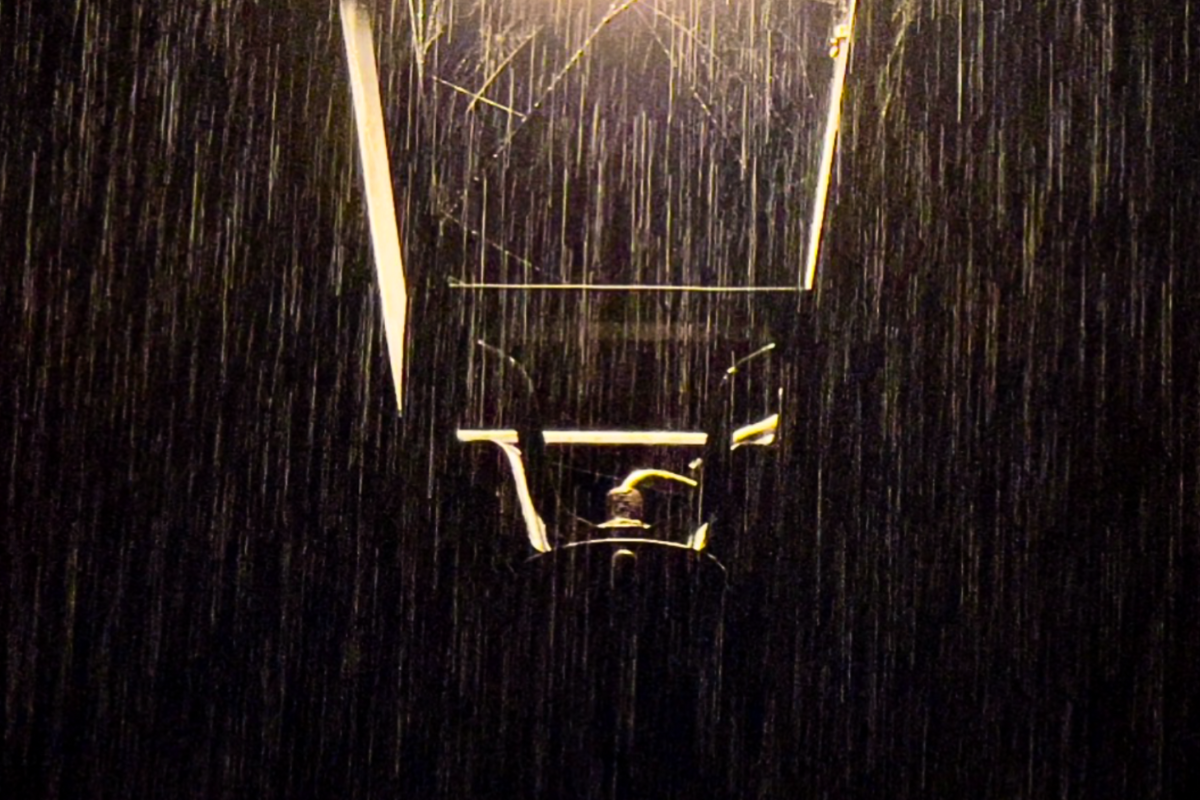
Shelter the Rain
This project emerges from Audio-lab’s invitation to develop small research exercises around their sound archive, specifically on the public sound map archive soinumapa.net, as well as to produce new documents that in turn enrich and nourish the archive itself.Soinumapa.net is a project that has been running for more than 20 years, based on ‘phonography’ or the art of recording the sounds of our environment, a collection of recordings made in the Basque Country that can be freely consulted, listened to, watched, read and reused for any creative, educational or research purpose.
The project proposed by Carmen Alonso pays attention to climatic phenomenology, specifically to rain, an indispensable condition for understanding the notion of natural landscape in the Basque Country and the Cantabrian mountain region.
How can rain be archived?
Starting from an a priori simple question, the guest researcher proposes an unprecedented project that raises different issues about the various forms of representation of the landscape in its both natural and cultural form. About the rain, data is stored, rainfall statistics are compiled, specific vocabularies are adopted to define its typology according to intensity, duration and origin.
Even more so nowadays, when global phenomena such as climate change seem to show radical changes in our perception of atmospheric conditions that affect our cultural imaginaries. However, a research in audiovisual archives reveals the rare presence of images and sounds with, about or related to rain. In fact, in most cases, we document the time before and after because there are a number of technical difficulties that prevent us from making such recordings directly under the rain.
The audio-visual recording technologies we use today cannot withstand the very intricacies of exposure to water and therefore to rain. As a result, with the exception of some ecological disasters, we have very few documentary records of rain, about how it influences our perception of the landscape, and about the identity and cultural processes that develop afterwards.
Therefore, Shelter the rain is a documentation, archiving and curating project, an attempt to record the cultural dimensions of an atmospheric phenomenon that is difficult to record. It is an experimental and innovative approach to how non-hegemonic archival exercises could be formulated through methodologies that equally draw from artistic approaches, archival practices and cultural perceptions.
A first approach mainly based on the collective imaginary around rain has resulted in interesting documents such as a toponymic list of rain nomenclatures (mainly in Basque, including dialects) or an exhaustive analysis of the soinumapa.net archive (from which dozens of sound recordings have been extracted/selected). At this moment, already immersed in production processes, a programme of actions is planned for the autumn equinox (22 September) and the winter solstice (21 December) of 2025, the period of highest rainfall of the year.
During this process, the guest has proposed to make a series of new recordings based on different exercises where the difficulty of the recording collides with the cultural importance of the place where these recordings are made. Through these sound recordings, the aim is to deeply explore the cultural implications of the climatic phenomenon, which in reality presents a reflection on the social relationships that we establish with water and how these changes the cultural values on which these same relationships are built.
The result of this exercise will be an exhibition on the online digital platform/gallery BRBA (brbaaudio-lab.org) which, during the active period of the project, will show a series of field recordings that will appear and disappear. The idea is to create a sound proposal in constant movement that evolves as the hydrological cycle does. The gallery will be fed, on the one hand, by a curatorial work that activates the material already hosted in Soinumapa.net and, on the other hand, by a fieldwork that contributes a new series of recordings to continue nourishing its collection. This work in the field is a personal exercise in listening, learning and reflecting on the technical difficulty that only allows us to make recordings sheltered from the rain.
In autumn and winter of this year, the first conclusions of this project will begin to emerge, but with a much broader perspective than that suggested by this initial research. We want to propose research models that may be shared with other partners/members of the Tramontana network, that could be replicated in other places, taking into account the specific realities of each territory. For this reason, we understand that the project, beyond this first residency/commission/exhibition, has great potential to be expanded in the near term through diverse formats such as artistic installations, collective publications, academic texts, specific audiovisual archives, among others.
After almost fifteen years working in the audiovisual sector, in 2019 Carmen Alonso decided to pivot her professional career by pursuing a Bachelor’s Degree in Information and Documentation at the Complutense University of Madrid. She combined her studies by starting out in audiovisual documentation at the consulting firm Alok Media and later as a freelancer. Her final degree project consisted of reconstructing person’s life through archival sources.
Her training as an archivist and her constant search for materials for the various documentation projects she embarks on give Carmen a very unique profile. As an example, her current research project focuses on safeguarding the film heritage of Asturias, a predominantly rural region that does not have a similar institution.