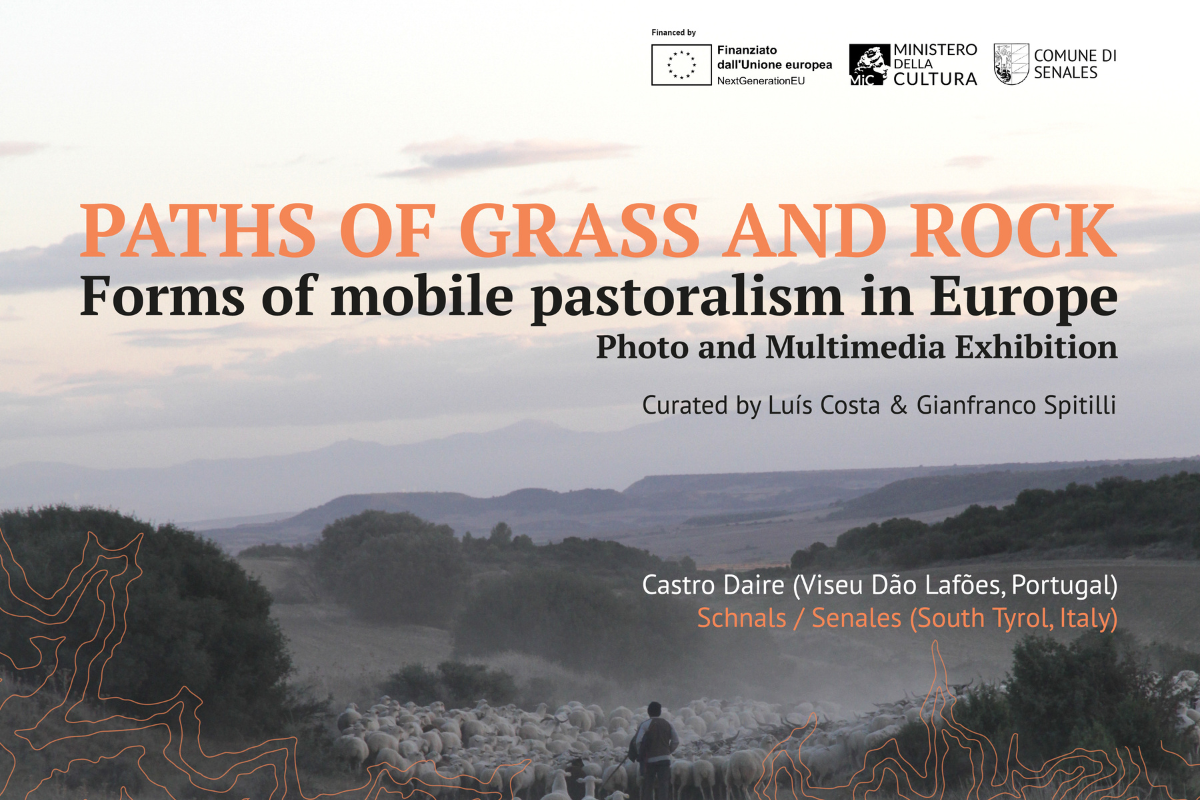
PATHS OF GRASS AND ROCK
Forms of mobile pastoralism in Europe
Multimedia exhibition
Curated by Luís Costa and Gianfranco Spitilli
Castro Daire Municipal Museum
Castro Daire (Viseu Dão Lafões, Portugal)
Opening: June 19, 2025, at 7:00 p.m.
Campus Transhumance
Schnals / Senales (South Tyrol, Italy)
Opening: June 22, 2025, at 11:00 a.m.
Bambun APS, PanSpeech, Binaural Nodar, the Municipality of Castro Daire (Portugal), and the Municipality of Senales (Italy) announce an international exhibition on transhumance in Europe, which will open in the same week in two different countries, Portugal and Italy, as part of the Tramontana Network, a project co-financed by Creative Europe.
Transhumance is a cultural expression of great relevance to different mountain cultures which, over many centuries, has generated transregional and cross-border mobility networks associated with the first exchanges between European peoples and cultures. The exhibition “Paths of grass and rock. Forms of mobile pastoralism in Europe,” co-curated by Luís Costa and Gianfranco Spitilli, addresses the vast theme of mobile pastoralism, of which transhumance is a notable example. The exhibition will be presented both at the Gorfer Mill, on the Campus Transhumance in Senales (South Tyrol, Italy), and at the Municipal Museum of Castro Daire (Portugal).
The exhibition is supported by the Italian Ministry of Culture, through the Municipality of Senales’ PNRR project for the regeneration of small cultural sites, cultural, religious and rural heritage, funded by the European Union’s NextGenerationEU program and it has the collaboration of the Tramontana project, co-financed by Creative Europe, the Caldas da Rainha Higher School of Art and Design (Portugal) and its LiDA research center, the University of Aveiro (Portugal) and its ID+ research center the University of Molise and its research center Biocult, and the PRIN Wildebate project – Coexistence, bio-cultural friction and pastoralism in protected areas, the University of Teramo, the Central Institute of Cataloguing and Documentation of Rome, the Ethnographic Museum of Transylvania (Romania) and the Digital Itineraries project, The project is also co-financed by the Directorate-General for the Arts (Portugal) together with the Municipality of Castro Daire (Portugal).
The exhibition offers a contemporary exploration of transhumance, a reality common to the entire European continent, through visual and audio research materials from eight different countries (Portugal, Spain, France, Italy, Poland, Romania, and Albania, all partners in the Tramontana network, joined by Austria) and relating to numerous mountain research contexts, from the Montemuro Massif to the Pyrenees, from the Alps to the Apennines, from the Carpathians to the Balkans. The producers of the exhibition thank all Tramontana partners, for providing research texts, photos and video documentation: Audiolab, Akademia Profil, Binaural Nodar, Eth Ostau Comengés, Radio Pais, Numériculture Gascogne, Binaural Nodar, La Leggera, LEM-Italia, Bambun, ORMA and G02 Albania.
Transhumance has been since 2019, included in the UNESCO Representative List of the Intangible Cultural Heritage of Humanity, and is thus linked to a vast European socio-environmental fabric, in accordance with the auspices of the Convention for the Safeguarding of the Intangible Cultural Heritage, encouraging a broad dialogue in the name of respect for cultural diversity and mutual understanding between peoples and regions.
Curators’ biographies:
Luís Costa (Lisbon, 1968) is a PhD researcher in site-specific art at the University of Aveiro and the School of Arts and Design (Caldas da Rainha). Since 2004, he has worked as a curator and programmer of contemporary artistic practices and as a sound and media artist. He is the coordinator of Binaural Nodar, a cultural organization in a rural context that has welcomed more than 200 national and international artists and researchers in the Portuguese region of Viseu Dão Lafões. He is the creator of the Binaural Nodar Digital Archive, a sound and audiovisual cataloguing project of the collective memory of Portuguese rural territories that is part of the European Tramontana Network. He is the author/editor of twelve books dedicated to artistic research, especially sound and media in rural contexts and rural ethnography, including the catalog “Three Years in Nodar: Context-specific Artistic Practices in Rural Portugal“ (2011), the book ”Tales of Sonic Displacement: SoCCoS, a sound-based artist residency network“ (2016), and the book ”Memoria Tramontana: Changes in rural Europe as seen by its inhabitants” (2019). Since 2007, he has been intensely involved in sound and media creation in rural contexts, through which he reflects on the specificities and changes of landscape, social, and cultural aspects of territories. Notable examples include Sound Villages (2007-2010); Sound Memory of Cork (2014-2015); “Perennial Bridges over Temporary Waters” (2018-2019), and “The Third River: An Imaginary Journey between Distant Waters” (2024), an artistic sound and audiovisual reflection about the Bisagno River (Genoa, Italy) and the Paiva River in Portugal.
Gianfranco Spitilli (Teramo, 1975). PhD in Ethnoanthropology, he is currently a researcher at the Department of Humanities, Social Sciences and Education at the University of Molise and professor of Cultural Anthropology at the Department of Communication Sciences at the University of Teramo. He conducts research in the field of visual and sound anthropology, religious ethnology, and anthropology of Christianity in Italy (Apennines, Alps), Belgium (Wallonia and Limburg), and Romania (Transylvania). He has created extensive sound and audiovisual documentation that has been used to create documentaries, museum installations, record productions, digital archives, and portals. In 2009, she won the “Nigra Prize” for anthropological research. Among her latest publications: (with A. M. Zocchi, ed.) “Images and social research. A dialogue between sociology and anthropology” (2020); “L’ascolto e la visione. Don Nicola Jobbi and the Central Apennines in the 20th century” (2020); (with G. D’Autilia, ed.) “Sono tutta negli occhi. Sebastiana Papa photographer” (1932-2002), exhibition catalog (2023); “Pandemic soundscapes. Collaborative Ethnographies and Multimodal Approaches to the Coronavirus Soundscape,” EthnoAnthropology, 11 (2023); “Grass roads.” Anthropology, mobile pastoralism and knowledge, in Don E. Bettini, D. Tondini (eds.), “A new renaissance for Europe: the role of research and training” (2023); “Sound ethnography and communication: sound as a cultural system”, in C. Corsi, P. Coen (eds.), “The professions of communicating: past, present and future” (2023).